Plone site
  • what is aut?
    • the aut
    • the team
    • the association
    • the building
    • the history
    • the commitment
    • the recognition
  • exhibitions
    • current
    • review
    • photo albums
  • events
    • calendar
    • series and formats
    • for children
    • review
  • publications
  • service
    • visitor info
    • tours
    • newsletter
    • infopoint aut
    • space rental
  • building in tyrol
    • architek[tour] tirol
    • tyrolean building database
    • "new building in tyrol"
    • visited “on-site”
  • magazine
    • aut: info
    • aut: feuilleton
    • aut: film
    • aut: radio
    • aut: mediathek
  • press area
  • support aut
    • become a member
    • sponsoring
    • aut: thanks
architek[tour] tirol – guide to architecture in tyrol aut. architektur und tirol is offering architek[tour] tirol as an efficient tool for you to organise your personal visit to contemporary buildings in Tyrol. https://architekturraumburgenland.at/aut/en/building-in-tyrol/architektour-tyrol https://architekturraumburgenland.at/aut/@@site-logo/logo-aut@2x.png

architek[tour] tirol – guide to architecture in tyrol

Weiter zur mobilen Version von: architek[tour] tirol
  • Deutsch
  • English
  • tours
  • architects
  • places
  • districts
  • functions
  • chronology
  • my selection
  • Absam
  • Ainet
  • Aldrans
  • Alpbach
  • Amlach
  • Angerberg
  • Aschau im Zillertal
  • Assling
  • Außervillgraten
  • Axams
  • Biberwier
  • Brixen im Thale
  • Brixlegg
  • Ebbs
  • Ellmau
  • Erl
  • Finkenberg
  • Fiss
  • Fließ
  • Forchach
  • Fügen
  • Fügenberg
  • Fulpmes
  • Gaimberg
  • Galtür
  • Ginzling
  • Gnadenwald
  • Haiming
  • Hall in Tirol
  • Hatting
  • Heinfels
  • Hopfgarten in Defereggen
  • Igls
  • Imst
  • Innervillgraten
  • Innsbruck
  • Inzing
  • Ischgl
  • Jenbach
  • Kals am Großglockner
  • Kappl
  • Karrösten
  • Kaunertal
  • Kirchbichl
  • Kirchdorf in Tirol
  • Kitzbühel
  • Kramsach
  • Kufstein
  • Kühtai
  • Kundl
  • Ladis
  • Landeck
  • Längenfeld
  • Lienz
  • Matrei
  • Mayrhofen
  • Mils
  • Münster
  • Natters
  • Nauders
  • Neustift im Stubaital
  • Niederndorf
  • Nußdorf-Debant
  • Obergurgl
  • Oberhofen
  • Obertilliach
  • Oetz
  • Patsch
  • Pettneu am Arlberg
  • Pfaffenhofen
  • Pill
  • Ramsau im Zillertal
  • Rattenberg
  • Reith bei Seefeld
  • Reutte
  • Rum
  • Scharnitz
  • Schönberg
  • Schwaz
  • Schwendau
  • See
  • Serfaus
  • Sillian
  • Silz
  • Sistrans
  • Sölden
  • St. Anton am Arlberg
  • St. Christoph
  • St. Johann in Tirol
  • St. Leonhard / Pitztal
  • St. Leonhard im Pitztal
  • Stams
  • Stans
  • Steinberg am Rofan
  • Tannheim
  • Telfs
  • Tobadill
  • Tux
  • Umhausen
  • Volders
  • Völs
  • Vomp
  • Vomp / Stans
  • Waidring
  • Wattens
  • Weer
  • Weerberg
  • Weißenbach
  • Wiesing
  • Wörgl
  • Zams
  • Zell am Ziller
  • Zellberg
  • Zirl

st. anton am arlberg

Übersichtskarte ausblenden
11 building(s) found:
01

Hotel Arlmont

Am alten Hof 1, 6580 St. Anton am Arlberg, A
Architecture: Tatanka (2007-2009) Builder-owner: Markus Stemberger TIP: Wellness and Fitness Area "cloud 9"

Hotels in the style of oversized farmhouses are still being built in Tyrol. The "Arlmont” – constructed by the Tatanka Ideenvertriebs GmbH – shows that the younger tourist generation are now starting to change their views. Instead of a carved wooden balcony, a balustrade made of a reddish coloured exposed concrete surrounds the building with its organic sweeping outline. Room high windows offer guests an ambience bathed in light.
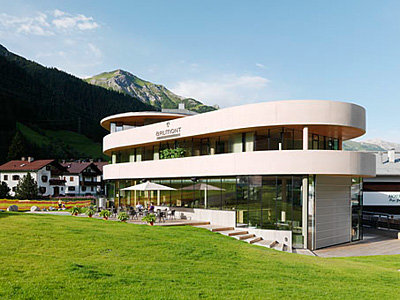
© Paul Ott
show map
02

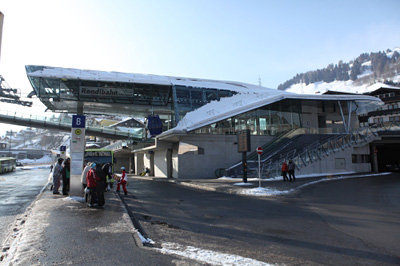
Rendlbahn Valley Station and Footbridge

Ingenieur-Julius-Lott-Weg, 6580 St. Anton am Arlberg, A
Architecture: driendl*architects (2009) Builder-owner: Arlberger Bergbahnen AG Open to the public: during hours of operation The mountain station was converted by the LEGOS architects, this included an extension building as a restaurant.

Just 150 metres from the Galzigbahn– also planned by the Driendl* architects – the new Rendlbahn connects the town centre with the other side of the valley for the first time. The lower level of the dynamic steel, glass and concrete building is used as a bus terminal, with guests being able to directly access the gondola’s boarding area via an escalator. A long sweeping footbridge connects the end of the ski slope with the valley station, which has been integrated into the surrounding area.

© Milli Kaufmann
to the nextroom entry of this building
show map
03

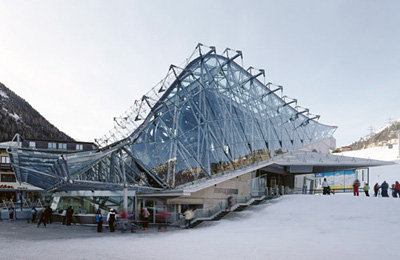
Galzigbahn Valley Station

Kandaharweg 9, 6580 St. Anton am Arlberg, A
Architecture: driendl*architects (2006) Builder-owner: Arlberger Bergbahnen AG Open to the public: during hours of operation The valley station was awarded a prize at the 2009 ISR Architectural Awards.

The Galzigbahn valley station presents itself as a very individual and at first sight, strange artificial design. However, the glass-steel-concrete building is by no means an architectural self-dramatisation, but a form developed directly from the innovative cable lift technology. A sweeping building with a glass roof rises above massive concrete head walls. This portrays the lifts sequence of motions and reveals the technical inner mechanism.

© Bruno Klomfar
to the nextroom entry of this building
show map
04

KIZ Kirchenzentrum (Church Centre)

Marktstraße 24, 6580 St. Anton am Arlberg, A
Architecture: AllesWirdGut (2003-2004) Builder-owner: Pfarramt St. Anton

AllesWirdGut constructed a church for the St. Anton Vicarage, with living accommodation for the minister and his guests, a parish office, a leisure room for local youths and, sleeping accommodation for those who would like to take a rest whilst on a pilgrimage along the "Way of St. James” to Santiago de Compostela. By making use of the slope facing towards the south and the spatial possibilities provided by a steep gable ended roof, it was possible to accommodate all functions in a compact four storey building.

© Hertha Hurnaus
to the nextroom entry of this building
show map
05

Nursery School

Auweg 10, 6580 St. Anton am Arlberg, A
Architecture: AllesWirdGut (2003-2004) Builder-owner: Gemeinde St. Anton In 2004 the nursery school was awarded a "Distinction of the State of Tyrol for New Buildings”.

Such as the Church Centre constructed by AllesWirdGut, the nursery school also forms an artistic unit in accordance with town planning ideas. The building is situated at the northeast edge of the plot, thus at a distance from the busy road. Large windows and a saw-tooth roof allow light to flood the inside of the building, which, right down to the very last detail, is adapted to suit children. In 2016, the kindergarten was expanded with a one-storey wooden building (architecture: Karl Gitterle).

© Hertha Hurnaus
to the nextroom entry of this building
show map
06

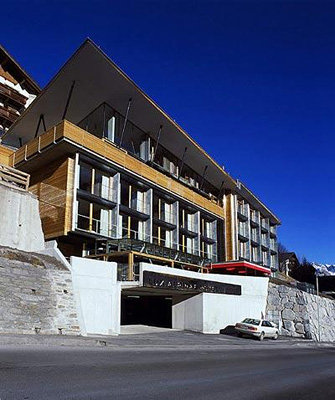
Hotel Lux Alpinae

Arlbergstraße 41, 6580 St. Anton am Arlberg, A
Architecture: driendl*architects (2003) Builder-owner: Sabine Kertess, Alexander Kertess TIP: The hotel has its own climbing wall between the building and slope.

For many years the steep south slope next to the road leading to the Arlberg Pass was considered as being unsuitable for development. To realise the "Lux Alpinae” construction, the slope was dug out three storeys deep, a two-part building was constructed close to the slope. The rooms, accessible via a loggia landing, have room-high glass fronts and protruding balconies facing towards the south. Finally, a curved shell roof gives the glass, steel and exposed concrete hotel building a dynamic look.

© Thomas Jantscher
to the nextroom entry of this building
show map
07

St. Anton Railway Station

Bahnhofstraße 6, 6850 St. Anton am Arlberg, A
Architecture: Manzl Ritsch Sandner (1999-2001) Builder-owner: ÖBB The centre of the village can be reached directly via a footbridge.

The double lane expansion of the Arlberg tunnel carried out in 1998 provided the chance to demolish the old railway station originally in the middle of the village and build a new one on the south side of the valley. The design, emerging from a Europe-wide contest, is a new interpretation of the "Railway Station”. The actual station building is not a solitary building away from the railway lines, but a part of the landscape designing process.

© Günter R. Wett
to the nextroom entry of this building
show map
08

ARLBERG-well.com

Hannes-Schneider-Weg 11, 6850 St. Anton am Arlberg, A
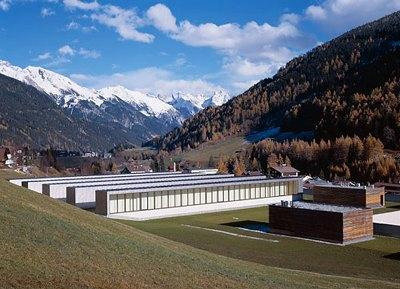
Architecture: Dietrich | Untertrifaller (1999-2001) Builder-owner: Arlberger Bergbahnen AG, Gemeinde St. Anton, Tourismusverband St. Anton Open to the public: during hours of operation (subject to a charge)
TIP: Restaurant "ben.venuto"

As part of the 2001 Alpine Skiing World Championships, Dietrich Untertrifaller completed the wellness and leisure centre, which during the championships served as a medical centre. The majority of its volume is embedded in the slope, the flat greened roof blends in with the surrounding area. From the slope one only sees three small "barn-like” structures and the 2000m2 large hall’s skylights at a right angle to the slope.

© Bruno Klomfar
to the nextroom entry of this building
show map
09

Hotel Anton

Kandaharweg 4, 6850 St. Anton am Arlberg, A
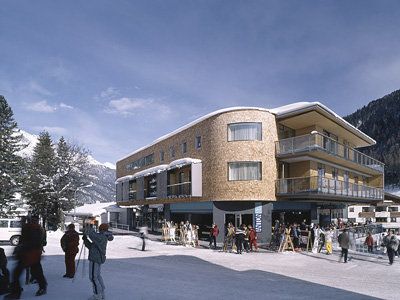
Architecture: Wolfgang Pöschl, Dieter Comploj (1999-2000) Builder-owner: Robert Falch

Due to the relocation of the railway lines, the family running the hotel had to close it down and relocate by opening a new hotel on the grounds of the old railway station. The hotel they built is a flexible useful house with rooms, which due to the sliding partitions, can be turned into completely functional apartments. The outside of the hotel is decorated with a wood-shingle-façade and large glazed areas; protruding alcoves in the rooms provide resting areas with a view across the mountains.

© Paul Ott
to the nextroom entry of this building
show map
10

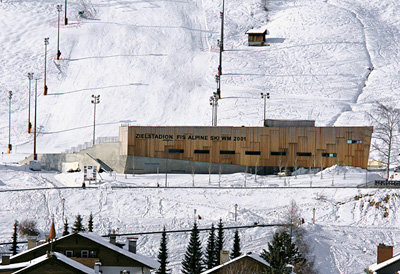
Finish Line Stadium – 2001 Alpine Skiing World Championships

Sonnenwiese, 6850 St. Anton am Arlberg, A
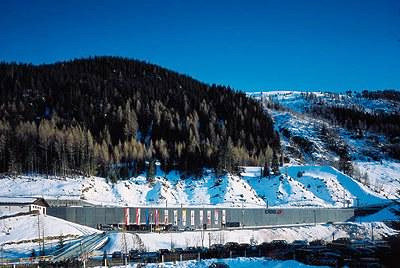
Architecture: Manzl Ritsch Sandner (1999-2000) Builder-owner: Arlberger Bergbahnen AG, Tourismusverband St. Anton, Gemeinde St. Anton

The finish line stadium constructed for the skiing world championships, were constructed by the same architectural-team that built the new St. Anton railway station. The tranquil wood-panel covered building is intertwined with the surrounding terrain in such a way, that the finish line stadium seems to be more of a topographic intervention than a building. With its many seminar rooms and fixed stand for 2000 persons, the finish line stadium is the perfect place for various outdoor events.

© Manzl Ritsch Sandner
to the nextroom entry of this building
show map
11

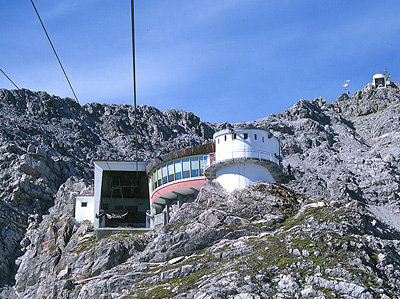
Vallugabahn (Mittel- und Bergstation)

Bergstation Galzigbahn, 6580 St. Anton am Arlberg, A
Architecture: Willi Stigler sen. (1951-1954) Builder-owner: Arlberger Bergbahnen AG Accessibility: von St. Anton aus mit der Galzigbahn zur Talstation der Vallugabahn

Mit der Mittel- und der Bergstation der Vallugabahn setzte Willi Stigler sen. zwei autonome und auf den jeweiligen Ort abgestimmte Baukörper in die Felsregion. Ganz der Sprache der 1950er Jahre verbunden, vermitteln die beiden Stationen mit ihren dynamischen, plastischen Formen und der Farbgebung Optimismus und Fortschrittsglauben. Wie Adlerhorste kleben sie selbstbewusst am Berg und lassen die Touristen die Dramatik der Landschaft "hautnah" erleben.

© B&R
show map
aut. architektur und tirol, in cooperation with the City of Innsbruck Urban Planning Department, Innsbruck Tourism , Tyrol Marketing and Chamber of Architects and Civil Engineers of Tyrol and Vorarlberg, is offering architek[tour] tirol as an efficient tool for you to organise your personal visit to contemporary buildings in Tyrol.
made by archTOUR
Informationen zu Cookies auf aut.cc

Auf dieser Seite verwenden wir Cookies und speichern anonymisierte, statistische Daten zur Auswertung der Website-Nutzung.
Mit dem Drücken von "OK" oder dem Weitersurfen auf dieser Website stimmen sie dem zu.
Detaillierte Informationen finden Sie in unserer Datenschutzerklärung.